
The Future-Ready Tree - Building Adaptability in an AI World
Education is about more than preparing for a first job. The Future-Ready Tree illustrates how strong foundations, deep learning habits, and adaptability prepare students to navigate changing careers, technologies, and industries. These capabilities develop through curiosity, persistence, critical thinking, and a lifelong willingness to learn. AI may accelerate growth, but strong roots provide the resilience to adapt, reinvent, and thrive in an uncertain future.

Growing the Future-Ready Tree
Building a future-ready student requires more than access to information and technology. Growing the Future-Ready Tree illustrates the essential components of effective teaching: supportive learning environments, engaging learning experiences, purposeful practice, meaningful feedback, and assessments that demonstrate genuine understanding. Through these practices, educators cultivate curiosity, critical thinking, independence, and adaptability. AI can enhance teaching through personalized learning, exploration, and timely feedback, but it is the skill and judgment of educators that transform these opportunities into deep learning and lasting human capabilities.

Becoming An Actuary in an AI World - 4/2026
What does it mean to become future-ready in an AI world? This slide presentation examines how artificial intelligence is reshaping professional expectations, learning, and decision-making, while highlighting both its opportunities and limitations. Success will increasingly depend on combining strong fundamentals, AI fluency, and independent critical thinking.
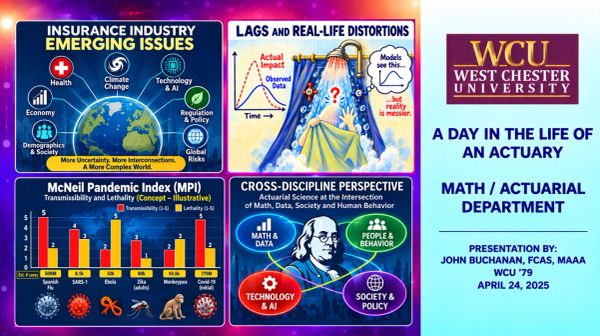
A Day in the Life of An Actuary - 4/2025
What does an actuary actually do? This slide presentation explores the blend of analytics, business judgment, emerging technologies including AI, and interdisciplinary thinking that helps actuaries solve complex real-world problems. From resumes and internships to interviewing and long-term career growth, this session shares practical advice for building a rewarding and adaptable professional career.
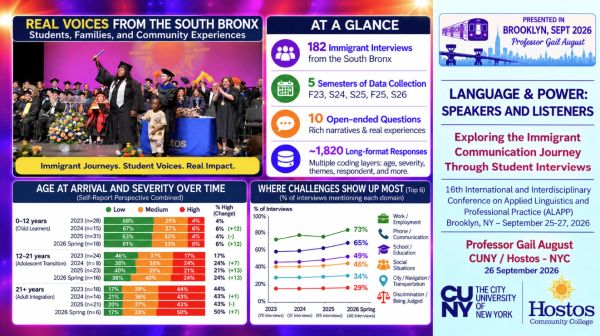
Language & Power: Immigrant Communication - Brooklyn - 9/2026
What happens when speaking with an accent changes the way others respond to you? Professor Gail August explores this question through years of research with multilingual students and immigrant families in New York City's South Bronx. Their stories reveal how language influences confidence, education, employment, and belonging while demonstrating that communication is a shared responsibility between speaker and listener.
Blending linguistics, education, and real-life experiences, this presentation offers a powerful perspective on language, identity, and the importance of listening with understanding rather than assumption.
Includes slides presented at Math Day at Hostos in NYC, investigating what cognitive science says about learning complex skills:
Language vs. Math: What Humans Are Born to Learn.
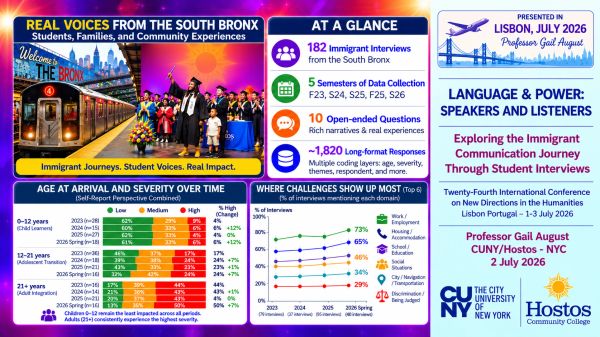
Language & Power: Immigrant Communication - Lisbon - 7/2026
What happens when speaking with an accent changes the way others respond to you? Professor Gail August explores this question through years of research with multilingual students and immigrant families in New York City's South Bronx. Their stories reveal how language influences confidence, education, employment, and belonging while demonstrating that communication is a shared responsibility between speaker and listener.
Blending linguistics, education, and real-life experiences, this presentation offers a powerful perspective on language, identity, and the importance of listening with understanding rather than assumption.
